Change Language :
Plastic Gears
Lubrication-free precision gears manufactured for exceptional wear resistance
Plastic gears are precision-engineered mechanical components with uniformly distributed teeth around its circumference, designed to transfer force between two rotating gears or between a gear and a rack. They are manufactured with engineering polymers rather than metal, including POM, nylon, PEEK, PET, and tribologically optimised polymers such as igus' materials.
The polymers used for igus® precision gears are manufactured with solid lubricants, making them self-lubricating with dry-running operation. Manufacturers are continuing to switch to plastic gears due to their reduced weight, low noise, improved corrosion-resistance, and lower-maintenance costs.
Why choose plastic gears?
trending_down
Reduced weight
format_color_fill
Corrosion resistant
volume_mute
Quiet operation
attach_money
Cost effective
Plastic gear types
Plastic gears are available in a range of designs to meet specific requirements in different applications. This includes load capacity, speed, noise reduction, efficiency, torque transmission, and more. igus® manufacture durable, high-performance plastic gears engineered for maintenance-free, lubrication-free operation and exceptional wear resistance. Tested extensively in-house, these gears are trusted across industries and can be tailored to your application with free expert advice, custom design support, and no minimum order quantity. Whether you need a prototype or full-scale production, we ensure a fast and reliable process.


Custom gears
Whether you need a single custom gear or high-volume production, we’ve got you covered. Our expert team offers a range of advanced manufacturing methods to deliver bespoke gears tailored to your exact specifications.
We’ll guide you through the most efficient and cost-effective production process and help you choose the ideal plastic material for your application.
We work with many customers who need custom gears—and we’re equipped to help you too!
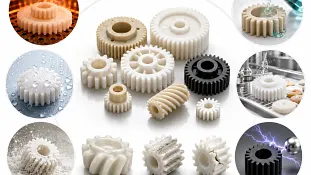
Benefits of igus® plastic gears
invert_colors_off
No lubrication needed
Custom gears available to order
shopping_cart
Shipping from 24 hours
published_with_changes
Long, predictable service life
Our manufacturing methods for plastic gears


Industries and customers using plastic gears


Frequently asked questions about plastic gears
A plastic gear is a round component that has uniformly distributed teeth around its circumference. It transfers force between two rotating gears or between a gear and a rack. Plastic gears are typically made of either POM, nylon, PEEK, PET, and tribologically optimised polymers such as igus' materials.
Common gear types include spur, helical, bevel, rack and pinion, and planetary gears.
Many plastic gears require silicone-based or synthetic greases, however igus® gears are manufactured using polymers where solid lubricants are integrated directly into the material, allowing dry-running operation.
Plastic gears are usually made of either POM, nylon, PEEK, PET, and tribologically optimised polymers such as igus' materials, where they are manufactured through injection moulding or 3D printing.
The module indicates the size of a gear. The module is calculated by dividing the pitch circle diameter by the number of teeth (m= d/z).
Please note that only gears with the same module can be combined.
Plastic gears can be used in all industries involving moving applications. Common industries where igus gears are used include automotive, railway, and e-bikes.
Depending on the area of application, we offer special materials which, for example, have FDA conformity or certain fire standards (e.g. the automotive sector) or similar.
Yes, the production of special geometries is possible and can be realised for all quantity scenarios thanks to our diverse manufacturing processes. We would be happy to advise you individually on your special geometry and the appropriate material. You can request your customised gear here
igus® plastic gears require no external lubrication and are therefore maintenance-free. Customers also benefit from a long service life thanks to wear-resistant materials, which we achieve through the formulations of the iglidur® materials. Compared to metal gears, plastic gears are low-noise and offer optimum emergency running properties. The tribological optimisation of the materials also results in a low coefficient of friction.
We have test rigs in our test laboratory to assess the performance of our gears in various scenarios. igus® also offer free samples for your application-related tests.
You can buy plastic gears directly from igus®, including their bevel gears, spur gears, and gear racks.
Rack and pinion gears are designed to convert rotational motion to linear motion and the other way around. They consist of a circular gear and a toothed rack.
Further information on our materials used in gear pinions


Consulting
I look forward to answering your questions

igus Australia1300 726 244Write e-mail
Shipping and consultation
In person:
Monday to Friday from 8 am - 5 pm.