Change Language :
3D printing plastic parts
Wear-resistant 3D printed plastic parts with up to 50 times longer service life than conventional materials.
3D printing, also known as additive manufacturing, is a process that produces components quickly, easily and directly from digital 3D models. 3D printing is perfect for rapid prototypes and one-off parts but can also be used for functional components and small production runs, without the need for expensive tooling. It is commonly used to manufacture custom wear parts and spare parts, including bespoke bearings, gears, and lead screws.
So, how does 3D printing work? How do you determine which printing process and material are right for your application? What key factors need to be considered when designing a part you intend on 3D printing? Discover resources on the different 3D printing processes, the range of materials and applications, and how wear-resistant plastics can be used to produce durable, low-friction components for moving applications. igus offers the only 3D printing filaments, powders, and resins specifically designed to reduce friction and wear.
Key benefits include:
- Maintenance-free operation with built-in solid lubricants
- Longer service life than standard plastics like ABS, POM, or nylon
- Durable parts comparable to injection moulding
Our 3D printing processes, services and materials


Who is our 3D printing service suitable for?
Industrial 3D printing offers the ideal solution for many crucial problems. Find out more about the typical challenges that the 3D printing service from igus® overcomes. Does your application have special requirements? Then you are welcome to discuss the solution directly with an igus® expert.

Broken component and a spare part is difficult to obtain?
A spare part can save your machine! Find out how Conti Tech hose GmbH was able to cost-effectively replace a defective cross-threaded lead screw using our industrial 3D printing service.

Do you need to deliver individual components or small batches quickly?
A small missing component can cost a lot of money. With 3D-printed linear actuators, which were delivered in a very short time, thyssenkrupp has prevented this. Find out more here!

Does the application require lightweight construction or lubrication-free components?
A metal gearbox may be too heavy for the desired movement. It also requires additional lubrication, which is not feasible in some environments. Cor.Sync solved both problems with us, find out how.

Special geometry of the component only realisable at high cost?
Once the perfect design for a component has been found, it needs to last. Discover how the Zurich University of Applied Sciences realised its creative project with industrial 3D printing!
3D printing resources


Technical information about 3D printing plastic parts
Our expertise is the result of years of experience in the world of 3D printing.
The 3D printing wiki contains the following:
- Frequently asked questions regarding the specification and processing of our 3D printing materials
- Design instructions and printing tips for industrial 3D printing
- Free topic-specific e-papers to download
- Recordings of past webinars and dates for future live streams
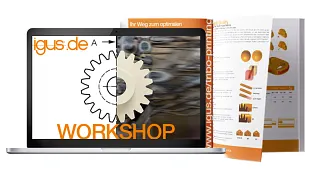
Frequently asked questions on 3D printing parts
In our FAQs you will find common questions from our customers and answers about our 3D printing plastic parts, material specifications and processing of igus 3D printing materials.
It's a process of creating three-dimensional objects from a digital file, layer by layer, using materials like plastic, resin, or metal.
A 3D model is sliced into layers, and the printer builds the object one layer at a time using additive manufacturing techniques.
Common types include FDM (Fused Deposition Modeling), SLA (Stereolithography), SLS (Selective Laser Sintering), and DLP (Digital Light Processing).
FDM uses melted plastic filament; SLA uses liquid resin cured by a laser. SLA offers higher precision and smoother finishes.
There are a range of materials such as PLA, ABS, PETG, resin, nylon, metal powders, and even biological materials. igus has its own range of wear resistant materials that offer alternatives to standard materials.
3D printing services are frequently used for industrial prototype manufacture, since procuring an industrial 3D printer is not cost-effective unless the company in question possesses the necessary expertise and uses the printer regularly to manufacture models and series.
3D printing service providers usually have not only the necessary expertise, but also several 3D printers, allowing them to select the method best suited to the application.
Depending on method, it is also much more cost-effective to engage an external service provider because such methods as laser sintering involve the regular manufacture of large batches of parts for various customers, greatly lowering production costs for individual parts and for individual customers.
The strength and durability of a 3D printed plastic part depends on the material and the application parameters. If you need help finding the best material or process for your components, please contact us or use the 3D print tool.
To design a part for 3D printing simply design your component as a CAD file. Once the CAD file is generated, you can drop it into our 3D printing configurator and get your price.
You can 3D print parts using the igus 3D printing service. Simply upload your CAD file to the free online configurator to get started.
NEW- 3D printed product turner
A new product recently introduced to the market is the 3D printed product turner, ideal for the packaging and beverage industry.
Precise product turning of items such as beverage cans, tins and jars is a crucial step in conveyor belt systems in the beverage, cosmetics and food industries. High volumes and speeds require a solution that is cost-efficient, flexible and durable.
Made of wear-resistant iglidur i150 tribofilament, our 3D printed product turners offer manufacturers a 70% reduction in production costs and over 90% on material, all while reducing the CO₂ footprint by over 85%. The customised design makes the turners adaptable for all can formats and enables easy cleaning through the integrated maintenance opening.
Customer applications and live examples
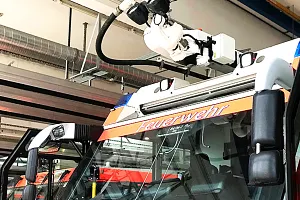
Our customers often require 3D printed components to be lubrication and maintenance-free. However, igus also fulfils other application-specific requirements with the 3D printing service.


Consulting
I look forward to answering your questions

igus Australia1300 726 244Write e-mail
Shipping and consultation
In person:
Monday to Friday from 8 am - 5 pm.