Change Language :
3D printer filament
Engineering filaments used in FDM 3D printing
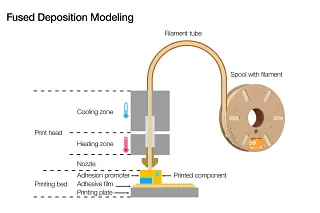
3D printer filament is the raw material used in FDM, which stands for Fused Deposition Modelling, a type of additive manufacturing. This material is used in 3D printers to create durable, high-precision parts in a layer by layer formation.
The manufacturing method is often described as a "continuous thermoplastic strand", highlighting how filament is heated and extruded through a printer nozzle to build components from a digital design, both simple and more complicated geometries.
What are the types of 3D printer filaments?
There are a wide range of materials that can be used in 3D printers, some are conventional engineering grades such as;
- PLA and PETG: ideal for general-purpose printing as well as prototypes
- ABS and ASA: perfect for printing functional parts
- PA (nylon): Designed for durability and mechanical performance
- PC: Focuses on strength and temperature performance
Which is the right filament for your application?
The right 3D printing filament is key when designing and producing wear resistant, reliable components. There are so many different filaments on the market, each offering unique technical properties such as flexibility, low wear, temperature resistance and food approval.
With such a large variety, choosing the right filament for each application can be complicated so this page has been designed to help you consider the application, combined with the material properties to establish the best 3D printing filament
What you need to consider when choosing the right filament
Operating temperatures
What is the range of temperatures you need the filament to withstand?
Friction & wear
Resistance when surfaces slide against each other
Mechanical & flexural strength
Resistance to applied forces and the maximum stress it can withstand before it bends or breaks
Chemical & environmental exposure
Does the material need to withstand any specific chemicals? Or will the parts be exposed to water or environmental elements?
Load
Does the material need to be able to take a high load? Or shock impacts?
3D printer type
Do you own a Bambu Lab? A Prusa? or Ultimaker? Or do you own a different brand?
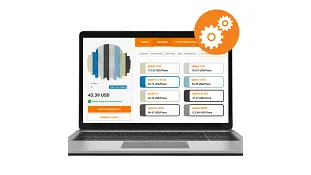
Instant quotation for 3D printed parts
For an instant quotation all you need is an stp file and in a few simple steps you have a price, lead time and service life data.
Conventional filaments versus engineering filaments
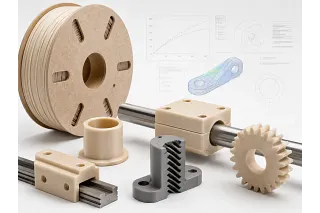
Many components don't specifically need engineering filaments and conventional materials such as ABS, nylon or PETG will do the job perfectly, however, if you want the part to be used as a wear part or working mechanical part then the materials need to be able to cope with more parameters.
Our filaments are engineering filaments. They are designed for use in real applications, experiencing wear, stress, load impacts, as well as potential environmental elements, washdowns and chemical contact.
We also offer FDA approved materials, suitable for direct food contact as well as PTFE-free and PFAS tested filaments. All of our filaments are rigorously tested so we are confident in their abilities to perform and offer a long service life.
With this range of variations in filaments, there is a material for every suitable application.
Our top selling filaments


Customer applications and live examples
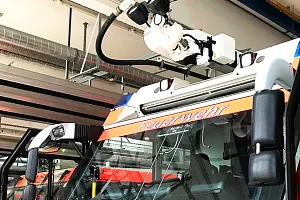
Our customers often require 3D printed components to be lubrication and maintenance-free. However, igus also fulfils other application-specific requirements with the 3D printing service.

FAQ's: Frequently asked questions
3D printer filament is raw material used in 3D printers. It is supplied in a thread style which is pulled into the 3D printer and is fed into a hot nozzle.
There is a large range of filament types, some core conventional ones such as PLA, PETG, ABS. Then there are more specialised materials such as Carbon fibre, ASA and metal filled materials. Our range of materials fall in between the two types. They are close to being a conventional material and work in a similar manner however there are elements of our materials that are specialised.
This will depend on the application so you need to look at the requirements of the application, check the printer compatibility and look at which type will work for your application.
For high friction, wear resistant parts, Carbon fibre and glass filled Nylon such as PA6-CF and PC12-CF are renowned for being the best however, there are more cost effective alternatives and again it will depend on the application.
All of these materials differ on flexibility, heat resistance, strength and the ease in which it can be used in the printer.
- PLA- easy to print but it has limited heat resistance.
- PETG- tough, great impact resistance and moisture resistance
- ABS- good strength, durability and heat resistance however can be difficult to print.
- Nylon- highly wear-resistant, tough and flexible.
Nylon from the conventional materials would be best suited for gears. As far as an igus material, i190 would be a good alternative.
As with all materials, it really depends on the application, neither is "better" than the other.
Reinforced filaments or PEEK are classed as the strongest. As far as igus materials P190 is the strongest
Yes many 3D printing filaments can be recycled through recycling programs.
3D printer materials are made of thermoplastic polymers which melt when heated and then as it cools, it solidifies.
This depends on the application, printer and your goal as to the best material to choose. Generally, people tend to lean towards PLA as the "go to" for general use, with PEFG and Nylon alternate options
Offering high impact resistance and flexibility PETG is less brittle and tougher than PLA. The tensile strength of PETG ranges from 40-50 MPa.
3D printing resources & technical information


Consulting
I look forward to answering your questions

igus Australia1300 726 244Write e-mail
Shipping and consultation
In person:
Monday to Friday from 8 am - 5 pm.